least action, principle of
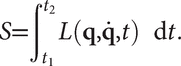
The principle of least action states that a trajectory of the dynamical system is an actual motion of the system if and only if the value of S is a stationary value. See also calculus of variations.
- parity check
- Parker, Matt
- Parseval's identity
- partial derivative
- partial differential equation
- partial differentiation
- partial fractions
- partial order
- partial product
- partial sum
- particle
- particular integral
- particular solution
- partition
- partition
- partition
- pascal
- Pascal, Blaise
- Pascal's theorem
- Pascal's triangle
- path
- path component
- path-connected
- path integral
- Pauli, Wolfgang Ernst